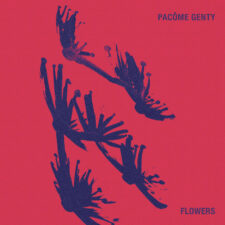

Pacôme Genty – Flowers
By Emmanuel Dosda
Picture : Terence Hassen
With Flowers, Paris-based musical polymath Pacôme Genty showers us with blossoms. A bouquet of ten multicoloured songs, snow white, sun yellow or pastel blue. A succession of Super 8 vignettes played back in slow motion. Psychedelic songs that feel immediately familiar, simply beautiful, yet reveal their secrets with each successive listen. Finely wrought songwriting, earworm melodies that get under our skin, poetic English-language lyrics and impressionistic brushstrokes combine to create ten remarkable pieces of music. An album to take shelter in…
Having summoned Greek mythology throughout his previous album, Hestia, Pacôme Genty now calls upon ancestral spirits on Ancient Spirit, a song about the search for a soulmate, bathed in dazzling light and set to a lilting bossa nova groove in the vein of Caetano Veloso. If Hestia unfolded as told by an imaginary narrator — the goddess of the hearth, giving voice to the emotions Pacôme was experiencing at the time (2024): reserve, modesty, joy… — then Flowers as a whole resembles a herbarium of a thousand shades, a spiritual account of a musical quest towards “that which transcends us”. A patchwork of styles: loping, whistling reggae rhythms (Flowers), cumbia-inflected sonorities (Book), rock-fuelled momentum (Down at Dawn)… All wrapped in a meditative folk cocoon and swaddled in a cloud of cotton wool. Even the punky Moving House seems to revolve at 78 rpm, so heavily are the hands of Pacôme’s clock weighted down. This is a record in no hurry, one that takes its time to leave a lasting impression, to cast its spell. Once the album has run its course, the temptation is irresistible: hit Play again and let it loop.
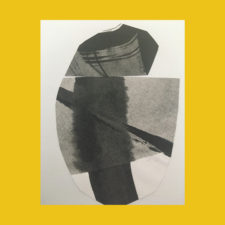
Following his collective adventures with Rrose Tacet and Erevan Tusk, Pacôme Genty has always preferred to work in good company. For Flowers, that means a small, trusted circle: the Laureau brothers (Fabrice at the recording desk, Nicolas providing musical support) and Julien Gasc, who contributed the angelic arrangements. The musician and his collaborators set out to “make different genres and colours work together while creating a sense of cohesion”, with the voice acting as the “binding vehicle” — much as it does in architecture. Bass, drums, piano, drum machines, clarinets and previously unheard samples steeped in hip-hop (as on Dead Ends): musician and painter Pacôme Genty builds his compositions in delicate overlapping layers, creating a picture somewhere between figuration and abstraction, much like the artwork he designed for the album.
The album’s shifting musical shades sit in intelligent harmony with lyrics that began life as a “first draft of automatic writing” before being refined. Pacôme has polished them into shape while allowing himself flashes of startling bluntness alongside more abstract, less narrative passages. On White and Flowers, images tumble into one another and themes recur like spectral motifs, mantras. He is finding his way beyond his mentors — Mark Hollis, Cass McCombs and others — without disowning them.
A poetics of ambiguity
“Make mistakes / Imitate first / Do your thing.”
A writing protocol with ambiguity as its guiding thread and letting go as its golden rule.
“A house drawn by a three-year-old is built.” “An apartment block is turned into a cemetery. The rooms become tombs.” In his book Œuvres, Édouard Levé describes 533 works he conceived but never actually made. The book has seeped into Pacôme Genty’s latest album, which is full of houses — places to move out of or sublet — as well as lists and refrains. A singer-songwriter and master of concealment, Genty started out from a particular premise: “The album is narrated by an unreliable narrator, a concept explored in the 1960s by writer Rudolph Wurlitzer, screenwriter of Sam Peckinpah’s Pat Garrett and Billy the Kid. I don’t know whether there are as many truths as lies on the album, but I did try to strike a balance between fictional elements and more autobiographical passages.”
An approach to writing with ambiguity as its guiding thread and surrender as its golden rule. The result is a poetic autofiction that pays tribute to literature (Book is a nod to Emily Dickinson), a chain of verbal associations and a sequence of chords, all distilled through a lengthy creative process. Genty lays his vibrato-laced voice over chord progressions that can be “harmonically disconcerting, with strange intervals” — he cites Syd Barrett and David Bowie — conjuring an atmospheric mood.
Ten recollections of dreams already slipping away. Ghostly glimmers that brush against the unconscious and filter the real.
Tracklisting
- Down at Dawn (4:24)
- White (3:28)
- Flowers (3:47)
- Subletting Void (3:04)
- Moving House (2:08)
- Ancient Spirit (3:30)
- Dead Ends (3:16)
- Book (4:25)
- Do Your Thing (4:17)
- To the Sun (2:27)